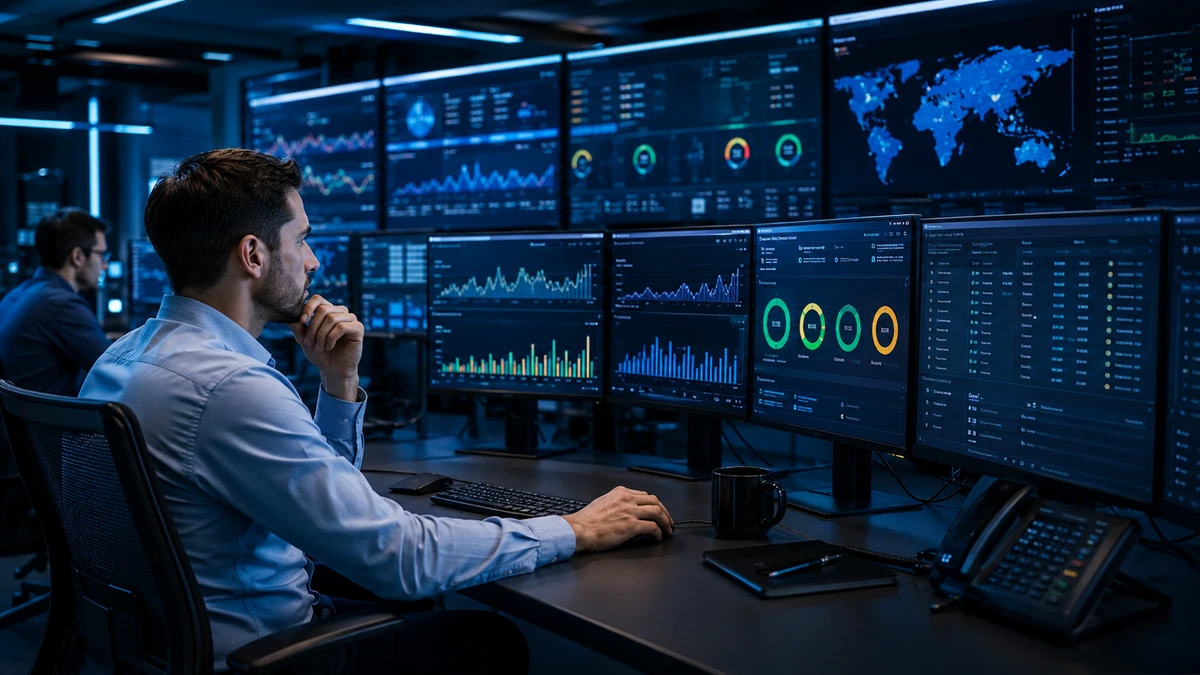
From reaction to anticipation
Many environments are monitored in silos: servers, links, applications or backups are tracked separately. Proactive monitoring connects those signals to detect trends and weaknesses.
What to measure
- Availability of critical services.
- Resource saturation and capacity trends.
- Backup status and restore tests.
- Alert quality, response times and escalation paths.
A governance topic
Monitoring becomes strategic when it feeds decisions: investments, contracts, SLAs, continuity and security. Indicators must therefore be readable by both IT and management.
Monitoring and Supervision of IT Assets: A True Governance ChallengeIn many organizations, IT monitoring is still perceived as a purely technical tool intended for IT teams.
However, the supervision of IT assets goes far beyond operational concerns. It has become a strategic issue related to governance, business continuity, and risk management.
At a time when information systems are becoming increasingly complex, interconnected, and critical, visibility into infrastructures is no longer a comfort — it is a necessity.
Seeing Better to Make Better Decisions
You cannot manage what you cannot see.
Servers, applications, network equipment, user devices, cloud environments, databases, business services… the modern information system is made up of a multitude of constantly evolving assets.
Without effective supervision, organizations expose themselves to:
- service interruptions;
- incidents that are difficult to diagnose;
- performance degradation;
- security risks;
- poor control of dependencies.
Monitoring transforms technical data into actionable information for decision-making.
Supervision therefore becomes a management tool.
Monitoring Is No Longer Just an IT Matter
Today, every technical incident can have a direct impact on business operations:
- customer service unavailability;
- slower operations;
- productivity loss;
- supply chain disruption;
- damage to the company’s reputation.
Monitoring must therefore be approached from a business perspective.
The real question is no longer simply: “Is the server running?”
But rather: “What is the business impact if this service becomes unavailable?”
This approach fundamentally changes the way infrastructures are supervised.
From Technical Supervision to Operational Governance
Modern supervision is not just about displaying red or green alerts on a dashboard.
It must enable organizations to:
- identify critical services;
- understand dependencies;
- anticipate incidents;
- measure performance;
- monitor service levels;
- improve overall resilience.
Monitoring tools are therefore becoming operational governance instruments.
They provide essential visibility not only for IT teams, but also for business managers and decision-makers.
The Importance of a Centralized Vision
In many environments, supervision tools are fragmented:
- one tool for the network;
- another for servers;
- a third for applications;
- Excel spreadsheets for everything else.
This fragmentation significantly limits analysis capabilities and slows incident management.
A centralized approach, on the other hand, makes it possible to:
- correlate events;
- detect anomalies more quickly;
- improve impact analysis;
- facilitate decision-making;
- strengthen IT governance.
It is also a key component for frameworks such as ITIL, NIS2, ISO 27001, or business continuity management.
Automation and Operational Intelligence
Infrastructures evolve too quickly to be supervised entirely manually.
Automation becomes essential to:
- discover assets;
- keep inventories up to date;
- generate relevant alerts;
- track changes;
- analyze trends;
- identify abnormal behaviors.
Modern solutions are progressively integrating artificial intelligence mechanisms capable of:
- detecting weak signals;
- anticipating certain incidents;
- reducing false positives;
- improving response times.
The objective is not only to monitor, but to make the organization more proactive.
Monitoring, Cybersecurity, and Compliance
Monitoring also plays a central role in cybersecurity.
Effective supervision makes it possible to:
- identify unusual behavior;
- detect network anomalies;
- track vulnerabilities;
- strengthen traceability;
- improve incident response capabilities.
With regulations such as NIS2, organizations must demonstrate greater control over their critical systems and operational risks.
Supervision therefore becomes an essential element of compliance and governance.
What Selection ICT Brings in Practice
At Selection ICT, we support organizations in implementing monitoring and supervision strategies tailored to their business and technical challenges.
Our approach aims to:
- improve visibility across IT assets;
- strengthen service continuity;
- structure IT governance;
- anticipate operational risks;
- facilitate decision-making.
Because effective monitoring is not limited to technology: it directly contributes to organizational performance and resilience.
Conclusion
Monitoring and supervision of IT assets are no longer purely technical topics.
They have become strategic levers to:
- better manage the information system;
- secure operations;
- improve service quality;
- strengthen resilience;
- support corporate governance.
Organizations that invest in intelligent supervision gain not only visibility, but also stronger anticipation capabilities and greater operational maturity.
Need a clear view?
Selection ICT helps turn these findings into priorities, roadmap and concrete actions.
Start a diagnostic